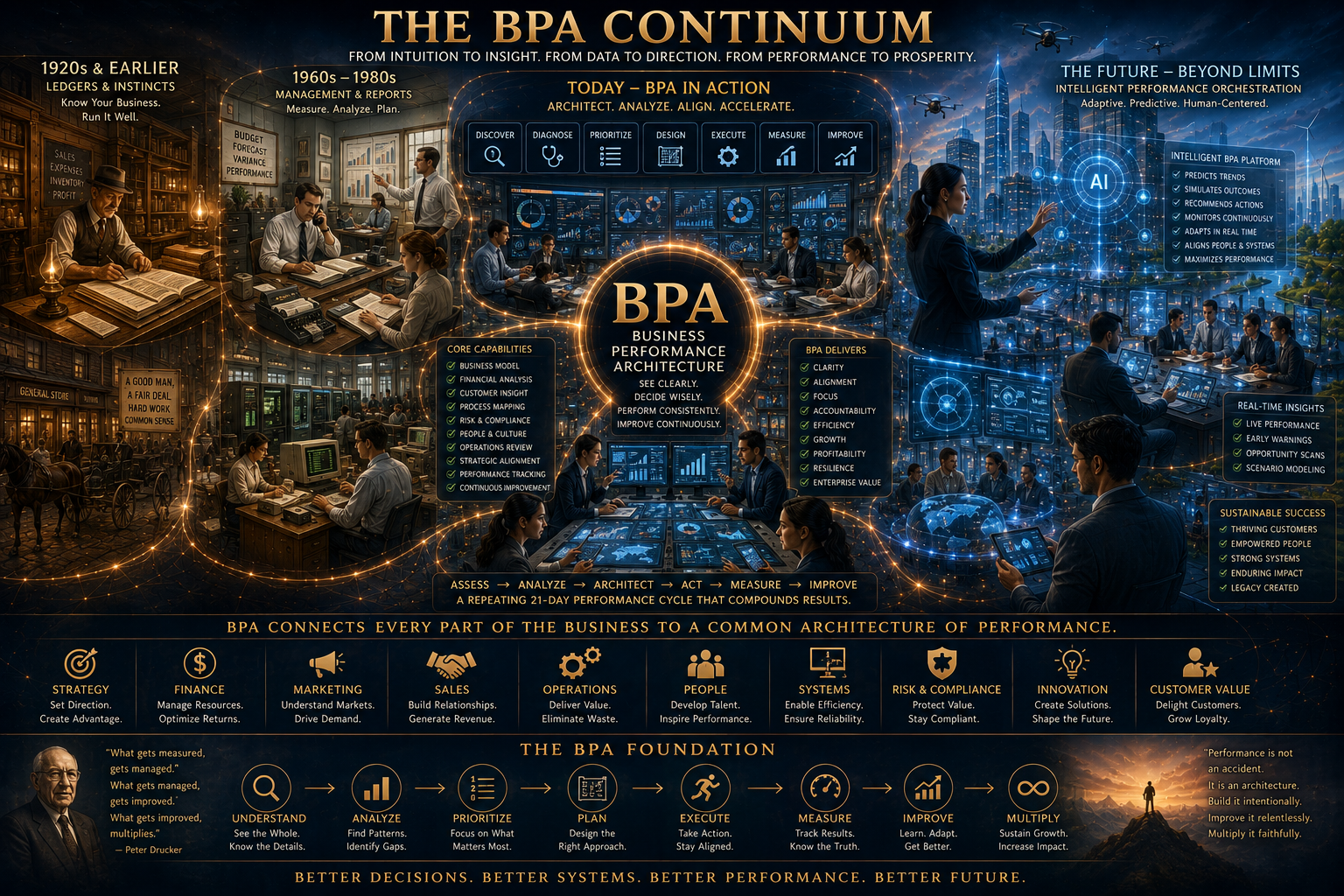
Business Performance Architecture is designed to help leaders see the organization as an interconnected whole. Businesses are frequently examined one department at a time: finance, sales, marketing, operations, technology, people, customer service, compliance, or strategy. Each discipline can produce useful information, but the most important performance problems often exist in the relationships between those disciplines.
The intellectual roots of this approach reach through accounting, audit, industrial engineering, statistical quality control, management consulting, systems thinking, operations research, organizational psychology, process improvement, and enterprise technology. Leaders such as W. Edwards Deming helped establish the importance of understanding variation, systems, feedback, leadership, and continuous improvement. Large professional advisory organizations developed traditions of examining companies across many functions rather than relying on a single departmental view.
BPA extends that whole-system posture into a living performance architecture. It asks where value is being created, where it is being lost, where resources are underused, where work is duplicated, where information arrives too late, where handoffs fail, where incentives conflict, where capability is missing, and where one apparently small weakness is creating larger downstream effects.
A business can grow revenue and still hemorrhage value through poor pricing, rework, excessive inventory, weak follow-up, underused labor, bad scheduling, unnecessary subscriptions, missed collections, poor procurement, customer attrition, unclear authority, or decisions made from incomplete information. BPA is designed to reconcile these conditions instead of assuming that one headline metric tells the story.
Within TOKORAI, BPA is the analytical and architectural view of organizational performance. It consumes information from CAS, TOK, HCA, OPS, QAR, and BVE and helps determine what those signals mean together. Its purpose is not simply to produce another report. Its purpose is to help leaders understand the system well enough to decide where attention, redesign, investment, or restraint will create the greatest value.