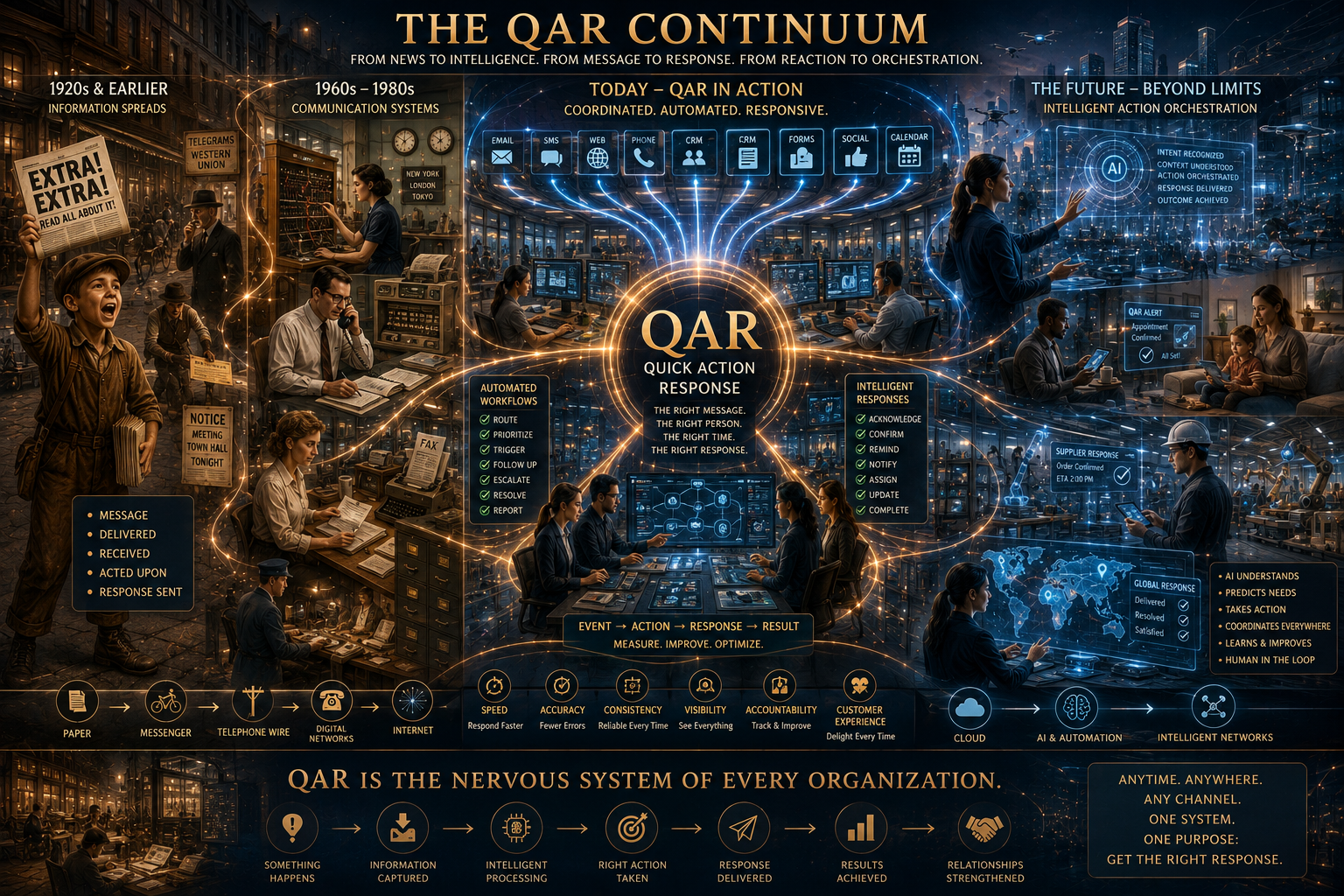
Quick Action Response addresses the gap between knowing something and doing something about it. Organizations receive signals constantly: a customer replies, a payment fails, a deadline approaches, equipment behaves abnormally, a lead requests information, an employee needs approval, a document arrives, a risk threshold is crossed, or a promised follow-up becomes due. Value is often lost not because the signal was unavailable, but because the response was late, unclear, or assigned to no one.
Earlier organizations relied on dispatchers, telephone trees, inbox trays, tickler files, calendars, bulletin boards, call sheets, supervisors, and written escalation procedures. These systems were often simple but effective because they created clear expectations about what happened next. Modern communication adds email, SMS, mobile notifications, workflow tools, event triggers, integrations, and automation.
QAR organizes these capabilities around action rather than technology. The central questions are: what happened, what does it mean, who needs to know, what response is required, how quickly should it occur, what happens if it does not occur, and how is completion confirmed? Automation may assist the process, but the architecture is defined by the action that must result.
The system is particularly valuable when volume increases. A handful of follow-ups can be handled from memory. Hundreds or thousands of signals cannot. QAR creates a disciplined response layer that allows routine events to move quickly while ensuring unusual or high-value conditions receive human attention.
Within TOKORAI, QAR connects information to movement. CAS may identify a relationship event, OPS an operational exception, BPA a performance concern, BVE an exchange opportunity, TOK a knowledge requirement, or HCA a capability gap. QAR helps ensure that the discovery becomes an appropriate next action instead of remaining an observation.