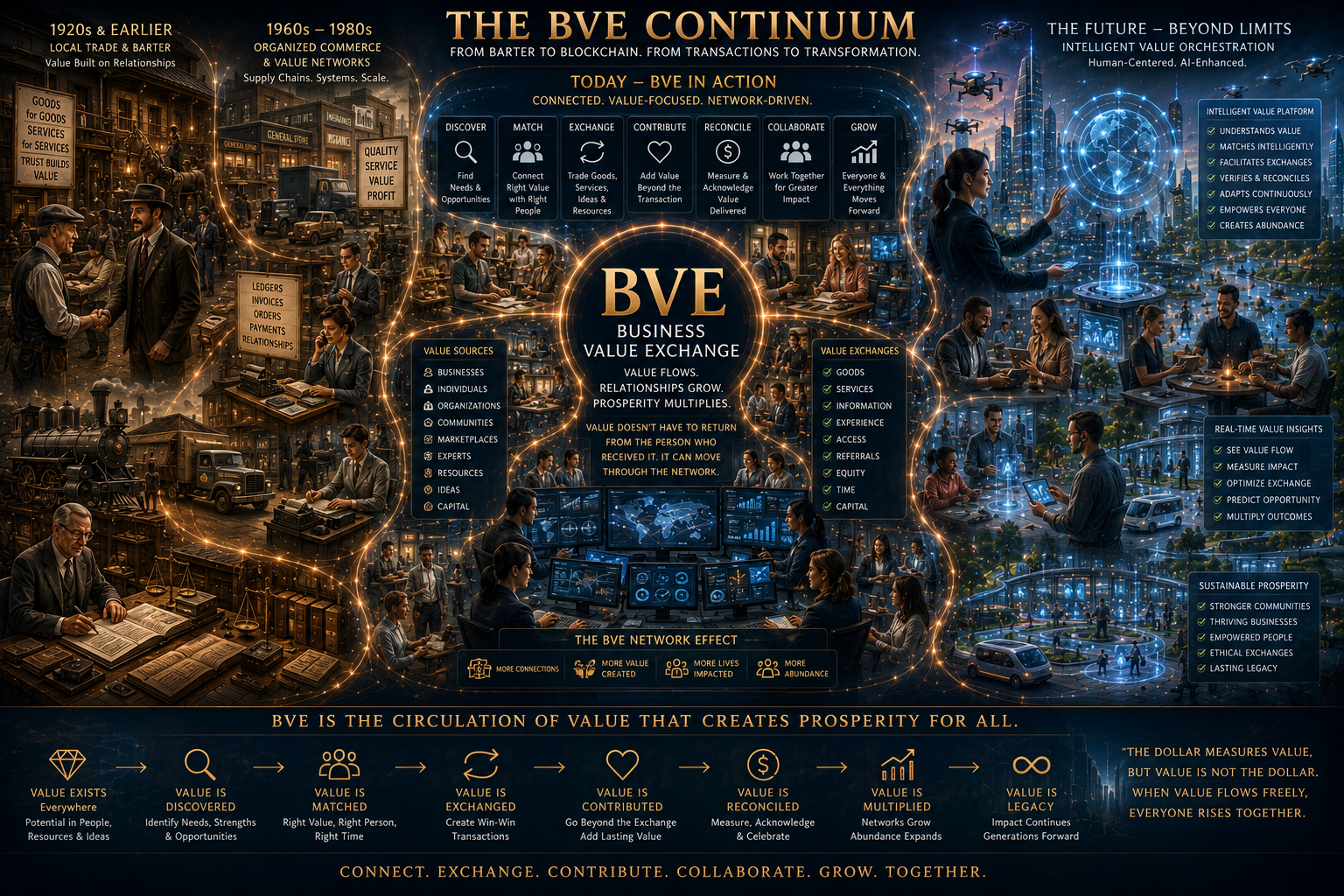
Business Value Exchange begins with the recognition that value moves through organizations and communities in more ways than a simple purchase. People exchange money, labor, expertise, introductions, access, equipment, information, referrals, services, unused capacity, collaboration, reputation, time, and opportunity. Traditional marketplaces capture only part of that activity.
Human economies have always included barter, reciprocal obligation, trade networks, guilds, markets, credit, brokerage, referrals, partnerships, and multi-party arrangements. Modern digital platforms have made matching easier, but many forms of useful value remain invisible because organizations do not have a structured way to describe what they possess, what they need, what they can contribute, and what kinds of exchange they are willing to consider.
BVE creates an architecture for identifying and matching those forms of value. A transaction may be paid, free, collaborative, reciprocal, referred, bartered, sponsored, donated, shared, or involve several parties whose contributions complete the exchange. The purpose is not to replace ordinary commerce. It is to make more forms of legitimate value visible and usable.
This can change how organizations think about scarcity. A company may lack cash for one need while possessing idle equipment, excess capacity, specialized expertise, customer access, training capability, space, or relationships that another organization values. Once those resources can be described and matched, exchanges become possible that would never appear in a conventional purchasing process.
Within TOKORAI, BVE is where accumulated knowledge, capability, relationships, operations, and performance can become reciprocal value. TOK helps describe knowledge, HCA describes capability, CAS develops relationships, OPS reveals capacity, BPA identifies needs and opportunities, and QAR coordinates timely response. BVE provides the environment in which those assets can meet.