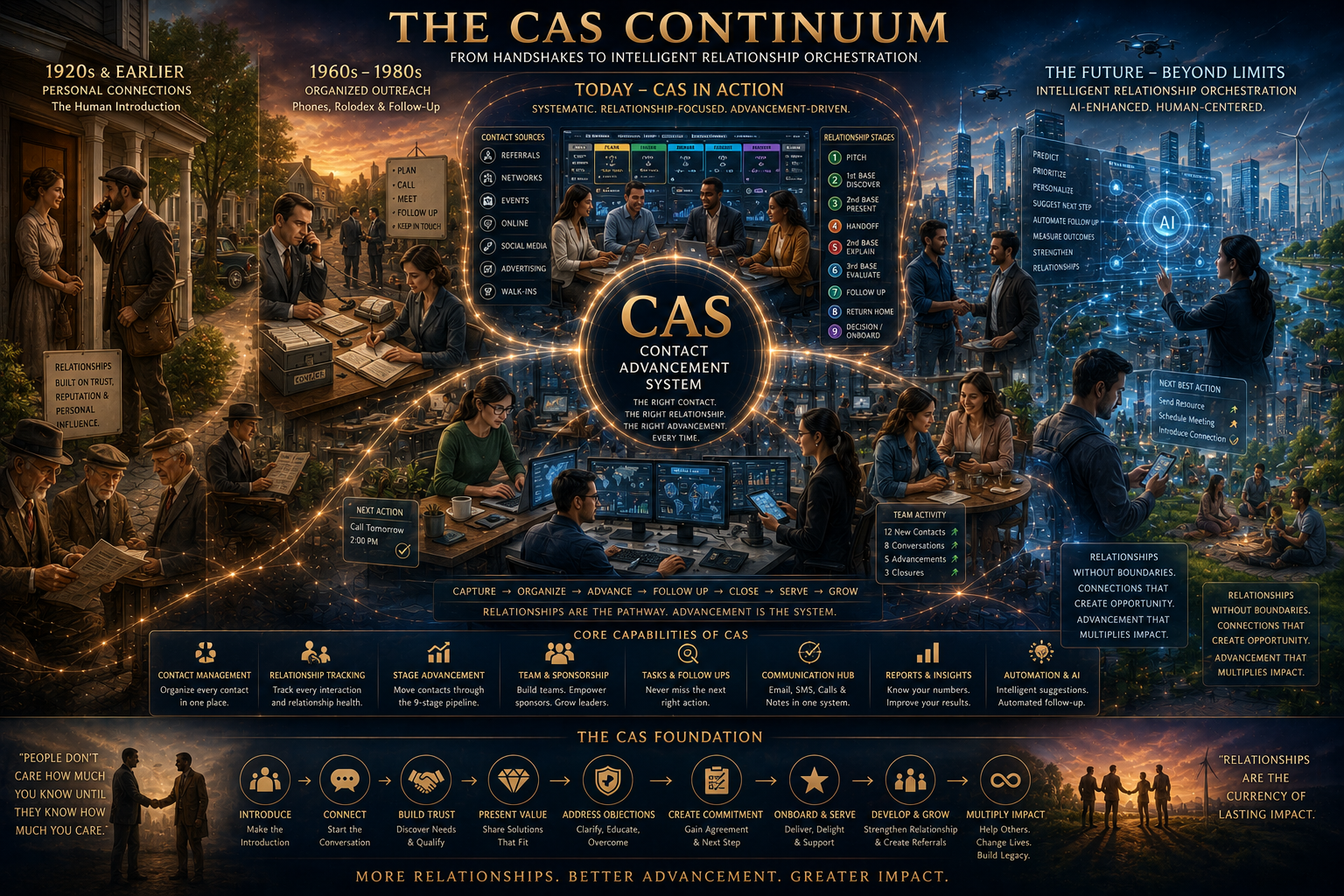
The Contact Advancement System is built around a simple reality: relationships rarely move forward because of one dramatic conversation. They advance through a sequence of contacts, discoveries, explanations, follow-up, decisions, and responsibilities. CAS provides an architecture for seeing that movement clearly rather than allowing opportunities and relationships to disappear into memory, scattered notes, or disconnected software.
Traditional relationship-building depended heavily on the discipline of the individual. Salespeople kept notebooks, index cards, appointment books, call sheets, territory maps, and personal memory. Those methods often worked remarkably well because they forced attention to people and next actions. Modern systems add digital records, messaging, scheduling, automation, team visibility, and network analysis. CAS attempts to preserve the personal discipline of older methods while gaining the visibility and coordination of modern technology.
CAS is not merely a contact database. A database can tell us that a person exists. CAS is concerned with where the relationship is, who is responsible for the next movement, what has already happened, what needs to happen next, what information has been learned, and whether a handoff or follow-up has been completed. It treats advancement as a managed process.
This becomes especially important when several people participate in one relationship. A person may be introduced by one individual, qualified by another, taught by someone else, followed up by another teammate, and eventually onboarded by an entirely different role. CAS creates continuity across those transitions so the person does not have to start over each time.
Within TOKORAI, CAS is the relationship and movement layer. It connects naturally to TOK when knowledge must be shared, HCA when people must be developed for a role, QAR when follow-up must occur at the right time, OPS when recurring contact processes must be performed consistently, BPA when relationship performance affects the organization, and BVE when relationships develop into exchanges of value.