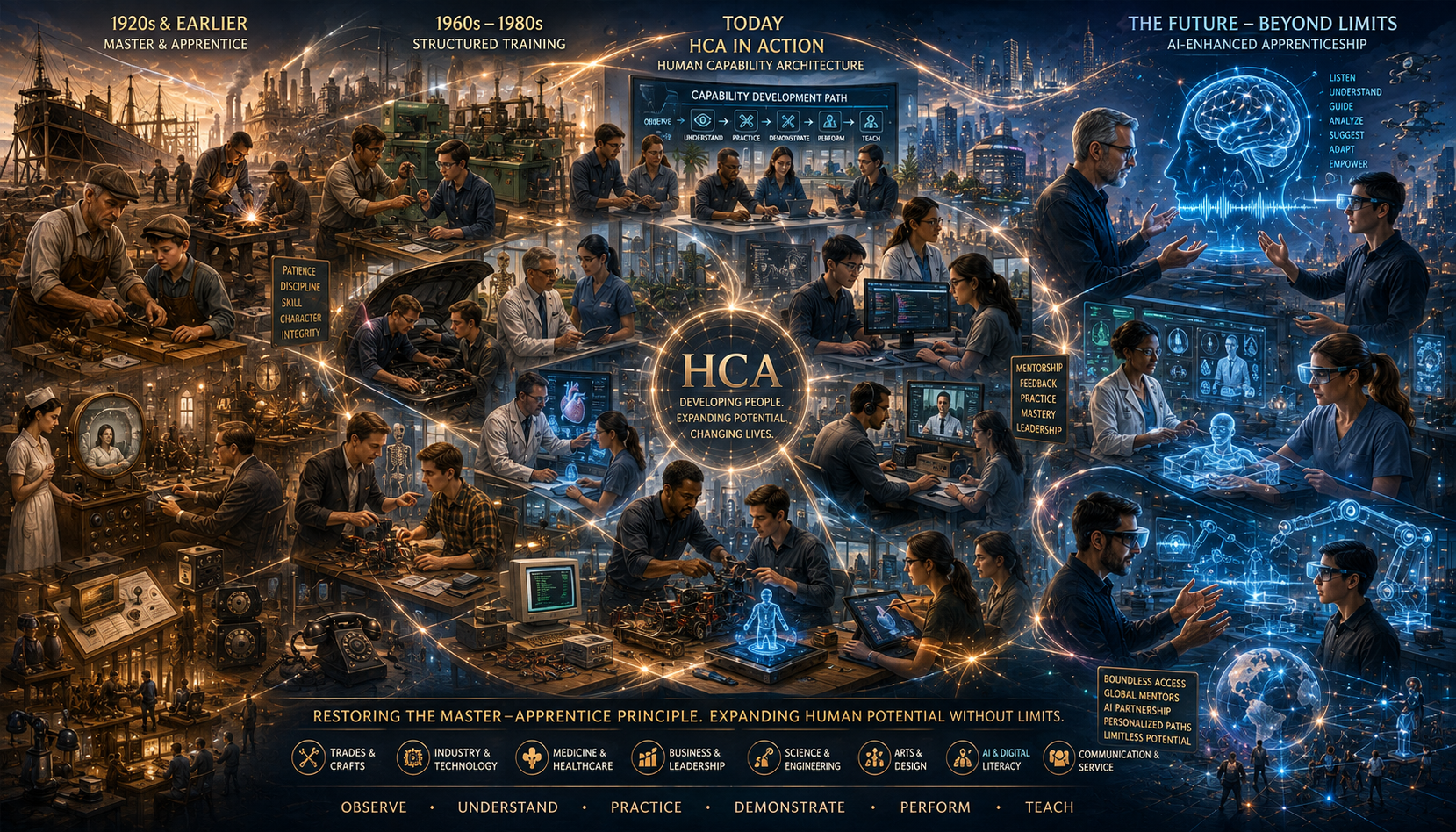
Human Capability Architecture begins where ordinary training often ends. Completing a lesson, watching a video, passing a quiz, or receiving a certificate does not necessarily mean that a person can perform the work. HCA is concerned with what a person has become capable of doing reliably, under real conditions, at an appropriate level of quality.
For centuries, capability was developed through apprenticeship, supervised practice, repetition, coaching, observation, correction, and gradually increasing responsibility. Industrial organizations later added formal training departments, competency standards, certifications, performance evaluations, and leadership development. Modern technology now allows practice, simulation, assessment, knowledge retrieval, remote coaching, and detailed progression tracking to be combined more deliberately.
HCA organizes that development across multiple dimensions: knowledge acquisition, skill development, practice, competency, assessment, certification, coaching, mentoring, experience, role readiness, leadership development, technical capability, progression, and mastery. The purpose is not to create credentials for their own sake. The purpose is to create demonstrable capability.
This distinction is critical in organizations. Two people can possess the same certificate and perform at radically different levels. One may understand the underlying principles, diagnose unusual conditions, teach others, and adapt under pressure. The other may only be able to repeat a procedure under ideal circumstances. HCA gives the organization a language and structure for distinguishing those levels.
Within TOKORAI, TOK transfers the knowledge; HCA develops the person. OPS then asks whether that capability is being converted into consistent execution, while BPA examines whether that execution is producing the intended organizational performance. This creates a continuous line from what a person knows to what a person can do and ultimately to the value that capability produces.