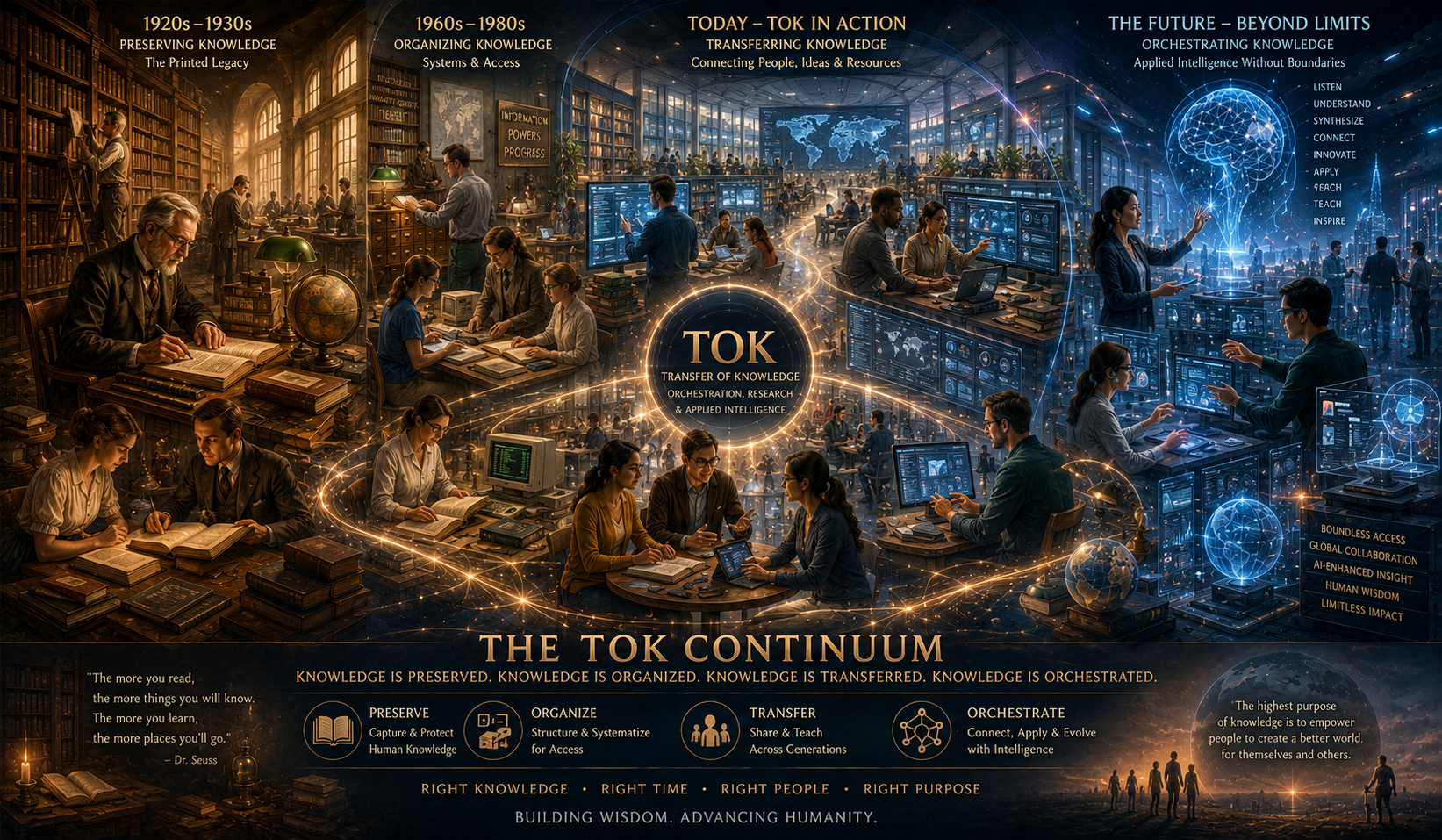
Transfer of Knowledge is the architecture for preserving what people know and making that knowledge usable beyond the person who first learned it. Every organization depends on knowledge: procedures, judgment, experience, methods, standards, stories, technical understanding, customer knowledge, leadership lessons, and the countless small decisions that experienced people make almost without thinking. When that knowledge remains trapped in individuals, the organization becomes fragile.
TOK treats knowledge transfer as a deliberate system rather than an informal hope that experienced people will somehow explain everything to the next person. It provides a way to capture important knowledge, organize it into understandable structures, teach it in a repeatable sequence, test whether it was understood, and confirm that it can be used and taught again. The goal is not merely exposure to information. The goal is faithful transfer.
Historically, human beings have transferred knowledge through oral tradition, apprenticeship, handwritten records, books, classrooms, manuals, recorded media, mentoring, demonstrations, and supervised practice. Each method solved part of the problem. Modern technology adds search, multimedia, structured repositories, collaboration, intelligent retrieval, and adaptive instruction. TOK brings these methods into one architecture while preserving the human judgment required to decide what matters and how it should be taught.
Within TOKORAI, TOK is the knowledge layer that supports every other system. CAS depends on people understanding how relationships advance. HCA depends on knowledge being available before capability can be developed. OPS depends on operating knowledge being clear enough to execute consistently. BPA depends on reliable information and shared understanding. QAR depends on people knowing how to interpret signals and respond. BVE depends on people being able to identify and communicate value.
TOK therefore sits at the center of a larger principle: knowledge has little institutional value if it cannot move. The architecture is designed so that important understanding can survive personnel changes, geographic distance, growth, generational transition, and technological change without losing its meaning.